
How Minimalist Backgrounds Make Dog Photography Stand Outs
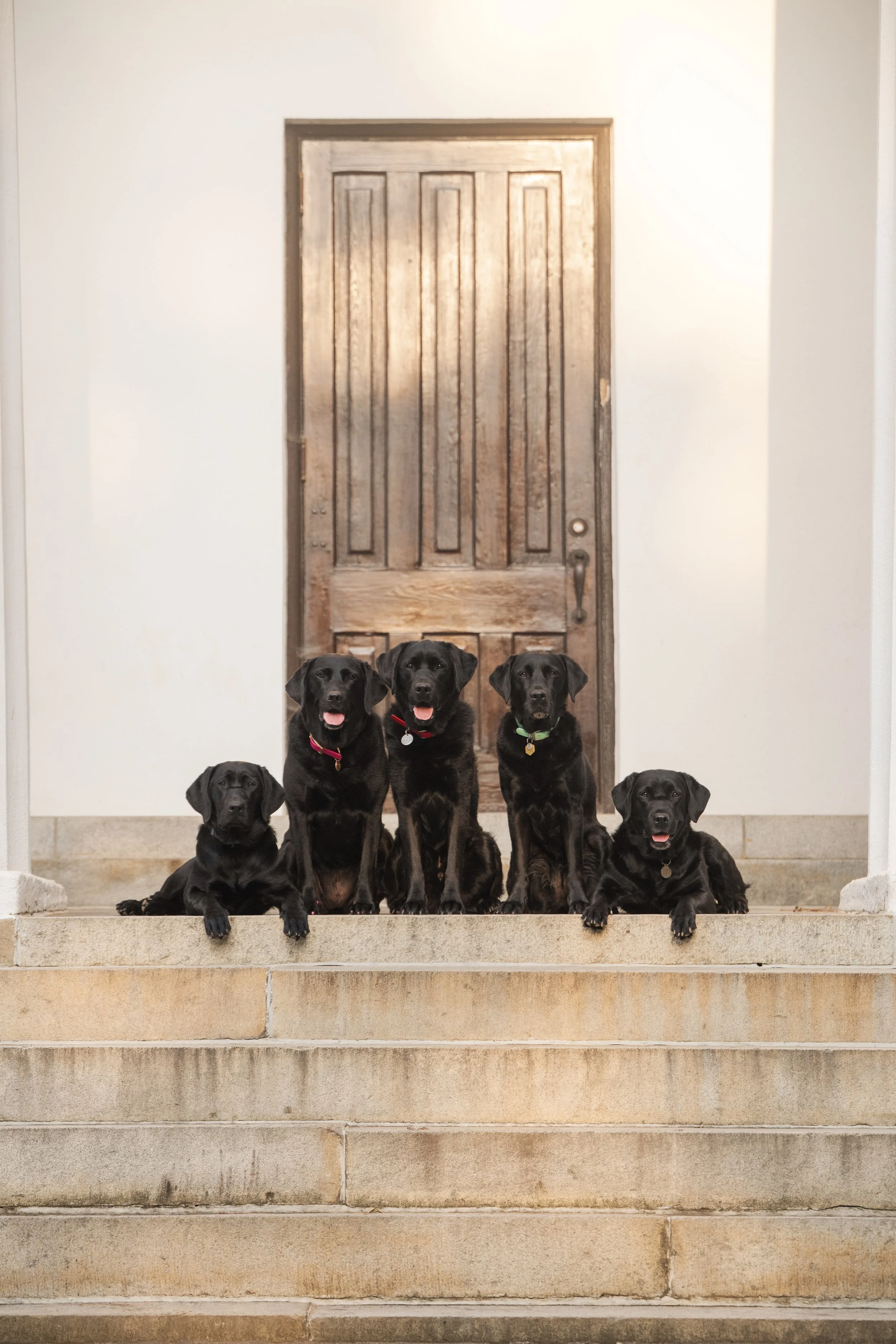
I recently photographed Donna's five — yes, five — black Labradors for an image I'd been conceptualizing for the International Pet Photographer Awards.
The vision was specific: five black dogs peeking from behind the white columns at UGA's North Campus in Athens, the first dog in crisp focus and each one behind her fading into progressively softer abstraction. Solid black dogs against a nearly all-white background. Almost no background at all.
It sounds stark. In practice, it was the simplicity that made everything work. With nothing competing for attention, the expressions and the staggered pattern had room to breathe. The dogs became the entire image — not dogs in a setting, but dogs as the setting.
That session got me thinking about why my favorite images — and my clients' favorites too — so often have one thing in common: a background that deliberately gets out of the way.

Photo of the four black Labs behind the white columns at UGA’s North Campus in Athens, GA
The Heartbeat of the Image Is Always the Dog
Everything else is the supporting cast.
That's not a principle I arrived at theoretically — it's something I noticed by looking at which images stop people. The ones with elaborate backdrops and interesting scenery are often pretty. The ones where the background goes soft and the dog's face fills most of the frame are the ones people reach for when they want to feel something.
Minimalism in photography isn't about removing interest. It's about directing it.
Why a Simple Background Makes a Big Impact
As a dog photographer, I hear this all the time: “Can we take Spot’s picture in front of some landmark?”
And while those kinds of places (the Instagramable hot spots, gazebos, bridges, cool tree, funky buildings, etc) might seem like a logical choice, they often compete with what really matters - your dog.
Too much detail in the background can make a photo feel like a tourist snapshot: your pup sitting next to a landmark rather than starring in their own portrait. Minimalist settings shift the focus back to what you love most - your connection, their expression, that little way they look at you.
I work frequently with natural backdrops: soft greens and browns of trees, weathered wood on a quiet dock, or simple stonework. These backdrops don’t feel blank. They feel gentle, intentional, and rich in tone. With a shallow depth of field (where the background blurs softly), everything outside of your dog's presence just melts away - and we’re left with something truly powerful.
What I Look For
Locations that feel calm and quiet. Minimalism doesn't require a studio — it requires a space where the background won't compete. Soft foliage. Neutral-toned structures. Open spaces without heavy foot traffic. For the UGA session, we went at sunrise during summer break, beating both the heat and the students. The columns were ours.
Backgrounds with complementary tones. I think about what will work harmoniously with your dog's coloring — and increasingly, with your home's decor. A portrait with a warm cream background against your warm neutral walls disappears into your home in the best way, like it was always meant to be there. A bold background that fights with everything around it never quite lands, no matter how beautiful the image itself is.
Long lenses and distance. One of the most powerful tools for a minimalist background isn't location selection — it's focal length. Shooting with a longer lens from further away compresses the background and creates separation between subject and setting that a shorter lens simply can't replicate. The background that looked cluttered from close up goes beautifully soft from 40 feet away with the right glass.
Direction and angle. I move constantly during a session, and much of that movement is about finding the angle where the background simplifies. Five feet to the left might put a parking lot in the frame. Five feet to the right might give me a clean tree line. The location doesn't have one right background — it has several, and part of my job is finding the one that disappears.
When the Studio Is the Answer
Sometimes the simplest background is no background at all.
Black and white studio portraits are the ultimate minimalist choice — every visual element removed except the dog, the light, and the relationship between them. When texture, coat detail, and expression are the entire image, the result can be more powerful than any outdoor location.
Studio sessions are also the right call for puppies who can't yet go to public spaces, for dogs who work best in a calm controlled environment, and any time a client wants that clean, timeless, graphic quality that only a studio can deliver.

Why It Matters
The goal with every session is to create images that feel like your dog - not stiff, not overly posed, but deeply personal and emotionally connected.
Minimalist backgrounds help us get there by eliminating the noise and letting your pup’s presence take center stage.