Every other week, the Unleashed Embark Challenge pushes me creatively to somewhere I wouldn't necessarily go on a normal session. This time the brief was Dogscapes — landscape photography with a dog in it. And if you know Rutledge, Georgia, you know that's a harder ask here than it sounds.
We don't have epic landscapes waiting around every corner. We have a coast, technically, but it's five hours from my front door. Mostly what we have is farmland and during this session time frame, we had rain. Days of it. I ended up with exactly one usable weather window for this entire challenge. One evening. And even that evening came with a heat index of 107 degrees and 84% humidity in the thirty minutes before sunset. We couldn't hike far — I had to think about everyone's safety, not just the shot. And laying on that rock to get low angles was brutal, like laying on a heating pad when it’s already 100 degrees.
The decision that had to be made
Once we were up on the rock and the sky finally broke open with light, I had one choice to make, fast, before the moment passed: expose for Turbo, or expose for the sky. I couldn't have both.
I chose the sky.
That decision is right there in the first frame — straight out of camera, no edits. Turbo drops into heavy shadow, nearly a silhouette. It's not a mistake. It's the trade I made on purpose, knowing I'd have to bring him back later.
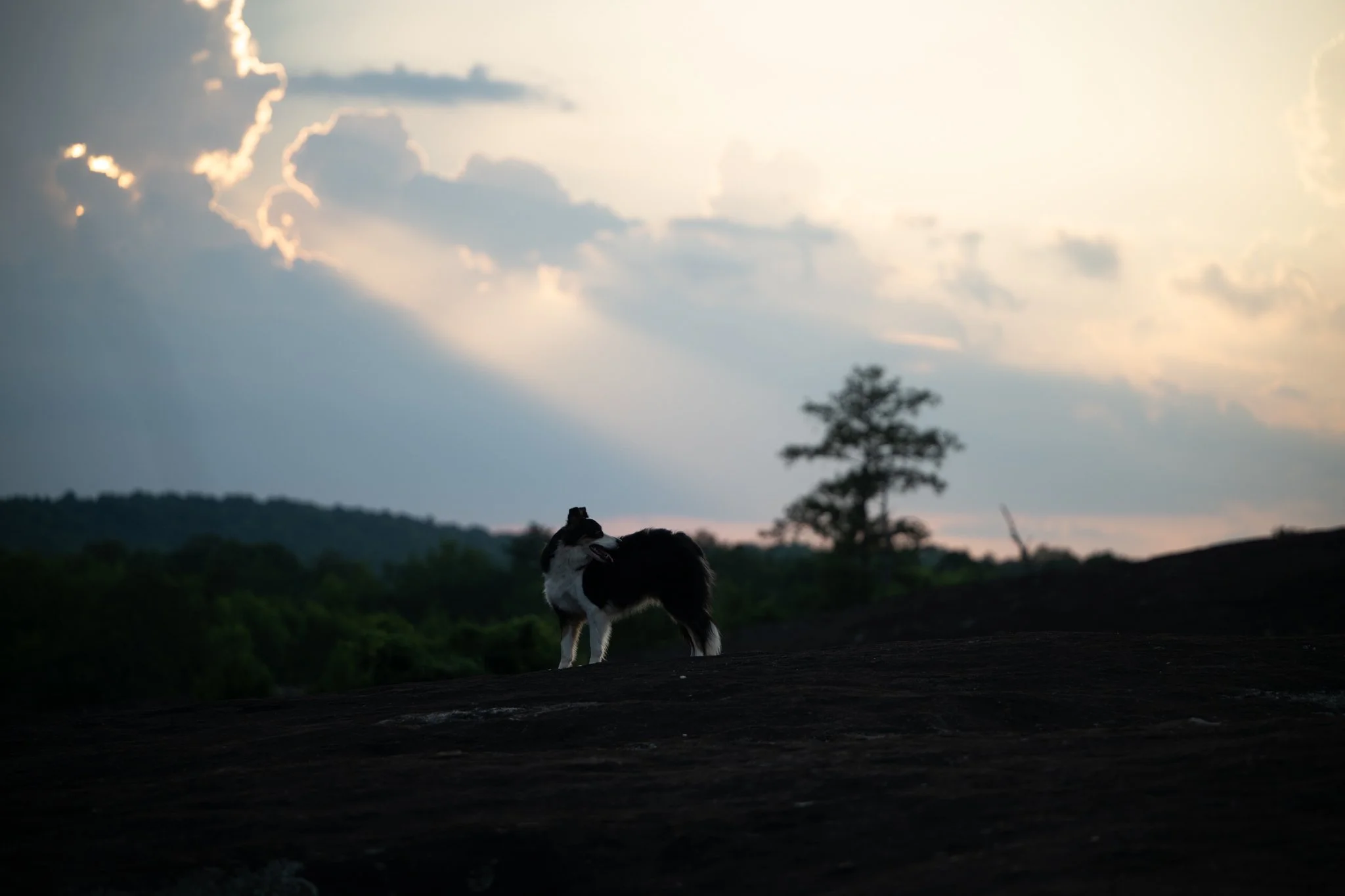
The RAW image straight out of camera.
I actually came away from that evening with three images I liked for different reasons, and each one taught me something about what "landscape" even means in a photo like this.
One had that gorgeous sky and light — but the dog was walking down the mountain, and I'd used a tree in the frame as my mental reference point for "straight" while shooting, only to remove that same tree later in editing. Once it was gone, so was my reference. Would it look straight? Was it more a sky photo than a landscape at that point? I wasn't sure.
Another had strong expression and focus — direct eye contact, a good tilt of the head — but the landscape behind him felt a little flat and unremarkable by comparison. And a weird reflection showed up in his eye against his black fur that I didn't love.
The third felt like the "safe" choice — a green, layered background, no sky drama — but with Turbo smaller in the frame, I lost some of the fine detail I could see in the others.
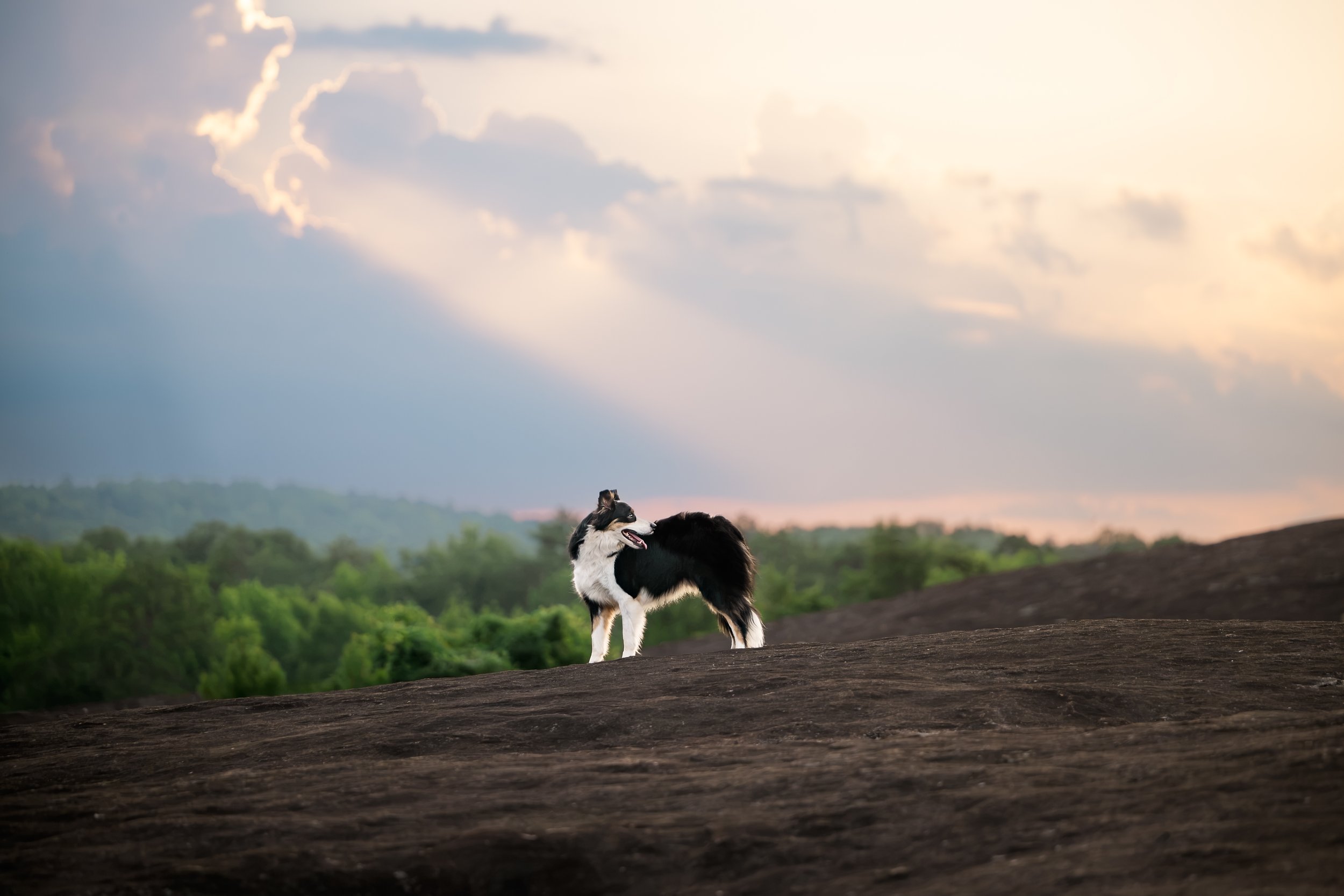
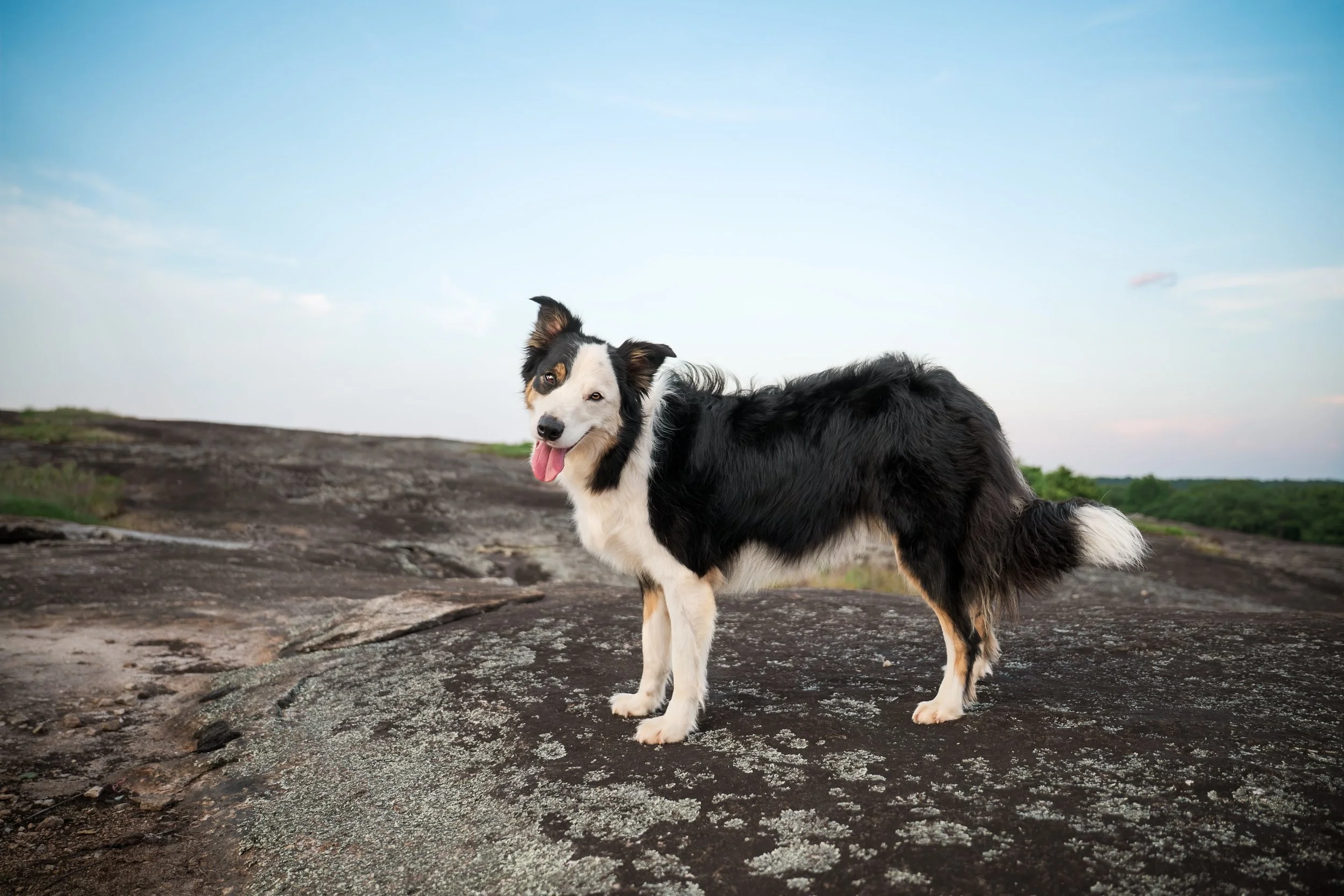
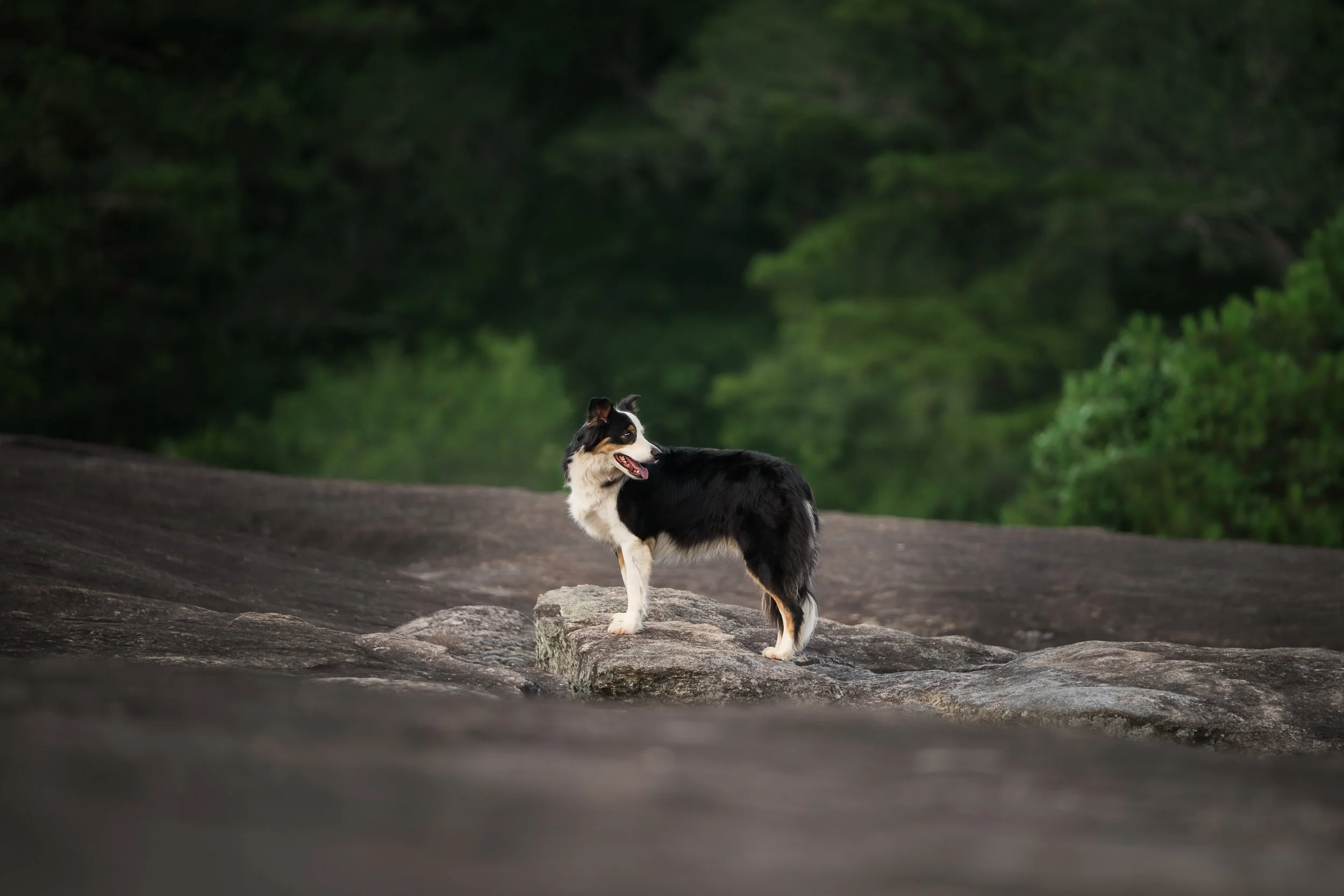
I ended up submitting the sky image. It was the riskiest of the three, but it was also the one that I kept coming back to.
The actual process, start to finish
Once I knew which image I had committed to, the real work started.
In Lightroom, I spent a lot of time on careful masking to balance the light and shadow areas — pulling as much real detail and shape back into Turbo as I could without losing the light & color that was genuinely in the sky. Lightroom masking has come a long way, but it still struggles in fur details and getting every little hair in the mask without creating a halo effect around the edge of your dog subject. My job in post was making sure Turbo could be seen the way my own eyes saw him standing there, instead of the flattened silhouette my camera's exposure setting gave me.
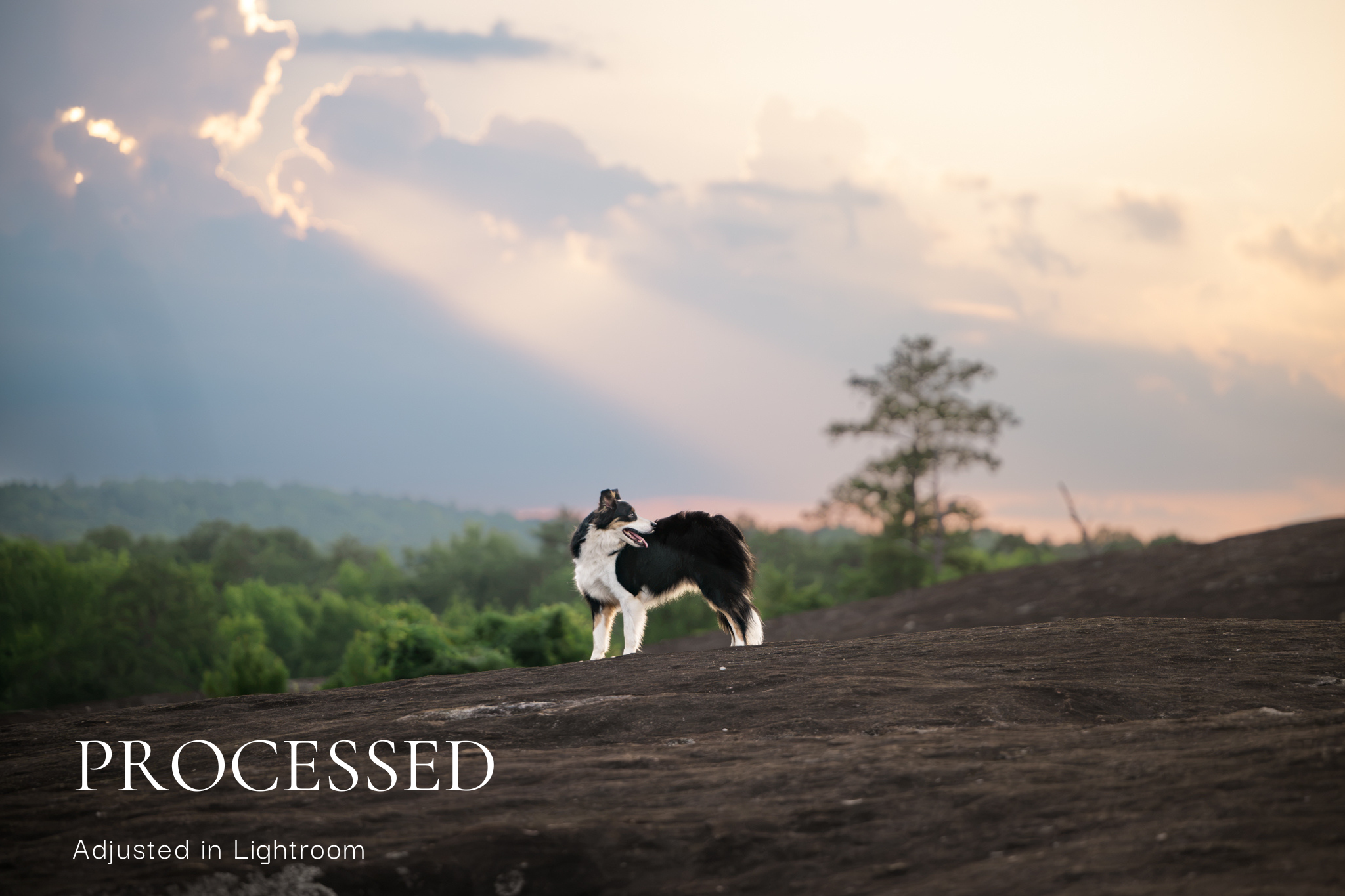
Exposure, highlights, shadows, whites, & blacks adjusted in Lightroom.
Here's why that trade-off exists (a quick lesson on dynamic range): my current camera, a Nikon Z8, has a sensor that can capture about 14 stops of light. My human eye is capable of something closer to 30 stops of light. A stop is the unit of measurement used in photography to describe exposure. If a camera has 14 stops of dynamic range, it means the brightest recordable tone is 16,384 times brighter than the darkest usable shadow. Each light stop doubles or halves the previous brightness level. Thirty stops equals 1,073,741,824 (that’s 1+ billion) times from the deepest shadow to the highest highlight. That gap is enormous, and it's something I have to think about constantly when I'm photographing dogs — whether it's a dog who's both black and white, where those two colors alone can span a huge range of stops, or a moment like this one, where the sky was so much brighter than Turbo that no single exposure could hold detail in both at once. My camera simply can't see the scene the way my eyes did standing there. So I had to choose which part of that range to protect in-camera, and then recover the rest.
From Lightroom, the file moved into Photoshop for finishing work — removing a tree that, in the end, didn't add anything to the story I was telling, cleaning up small distractions scattered across the rock, removing stray furs, and brightening and sharpening Turbo’s eyes.
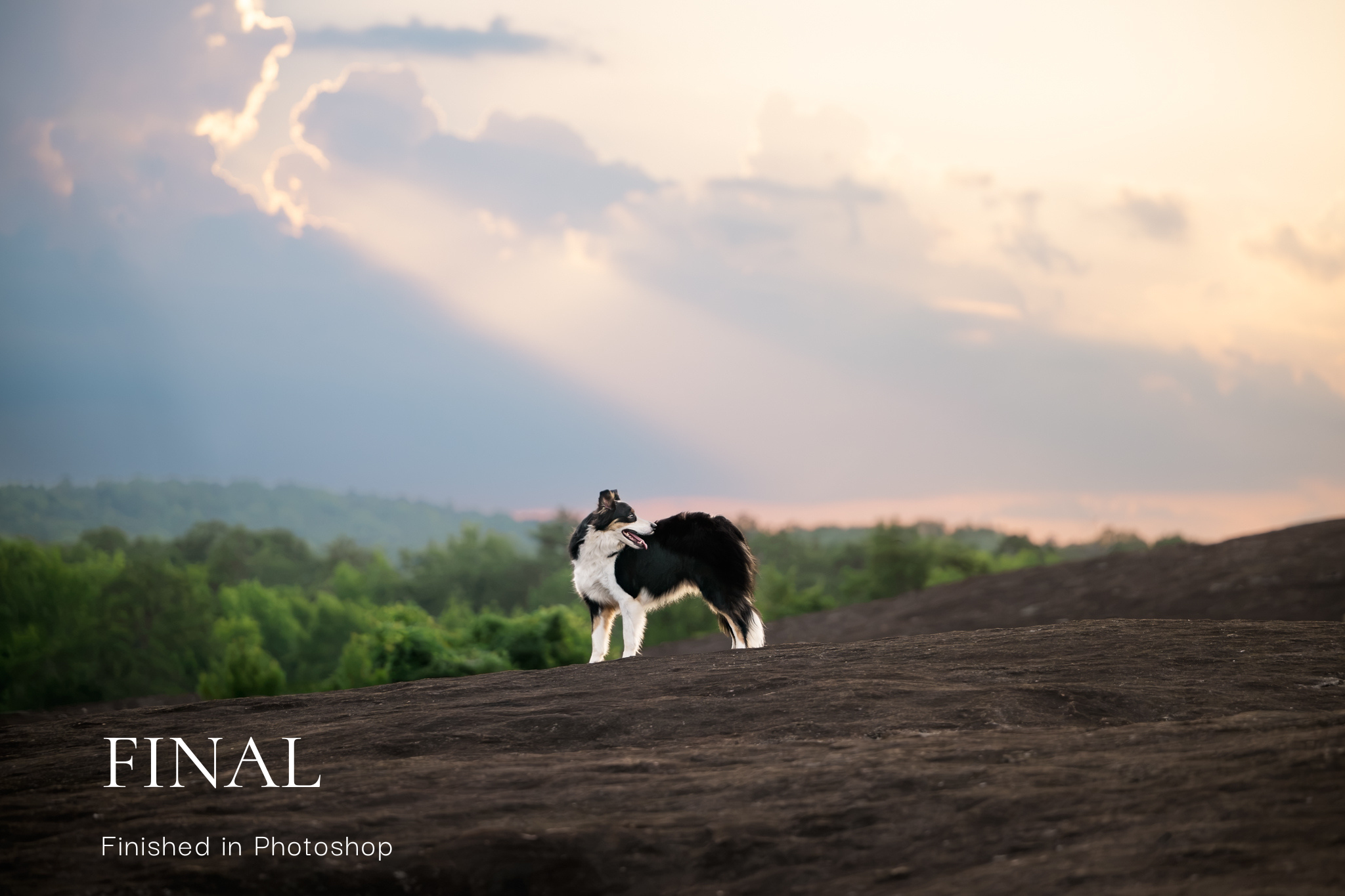
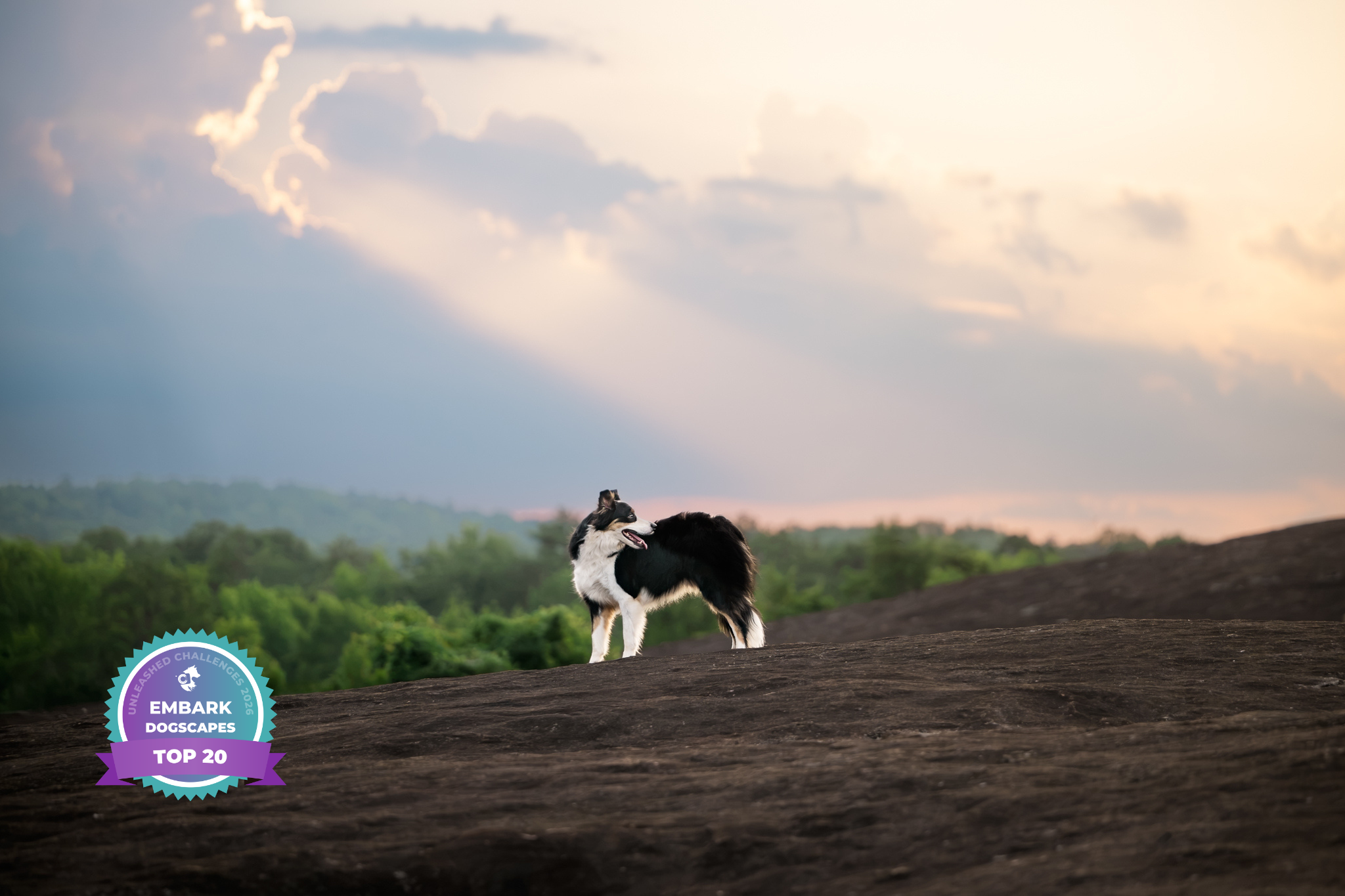
The final image, edited in Photoshop.
Why not just use off-camera flash?
Off-camera lighting is a tool I use. But it’s extremely limited in the field. Dogs aren't people — you can't explain to a dog why it needs to stay exactly here so a flash lights them correctly. They move, they wander, they follow their nose wherever it takes them. Telling a dog "I need you to stand right here, because this is the only place my flash is going to illuminate" just doesn't work the way it does with a human subject.
I also don’t travel with a crew of assistants. On location it’s me, my client, their dog (and every once in a while a friend if we need an extra set of hands). Off camera flash requires light stands, weights for safety, battery packs, umbrellas or other light modifiers, boom arms, and the flash itself. Suddenly we need an entire production crew dragging equipment around. There are pet photographers that work like that, and they create beautiful work. But, for me anyway, all of that extra equipment and people on set makes the job harder for the dog. There are more people they need to be comfortable with, there is weird equipment and flashing lights and tall modifiers they need to ignore, and the entire thing becomes a production that is no longer just about the dog being a dog in a beautiful place.
So to get to the image I already have in my head — the one my own eyes saw — means doing that work afterward, understanding every limitation the camera has and making split-second decisions to manage them, rather than wrestling extra equipment.
The result
This image placed in the Top 20 for the Dogscapes challenge. The judges called out exactly what I loved about it, too — Turbo's pose, the light breaking through those clouds, the sheer expanse of rock filling the foreground, the green mountains fading into the distance behind him.
Their one note: you can't quite see his feet.
They're right, and I'll take that note. I'm hoping to get back out on that mountain with Ali soon to reshoot it — this time getting him positioned a little higher on the rock so his feet are fully visible.
Top 20 Award for the Dogscapes challenge