
Nikki was my first best friend.
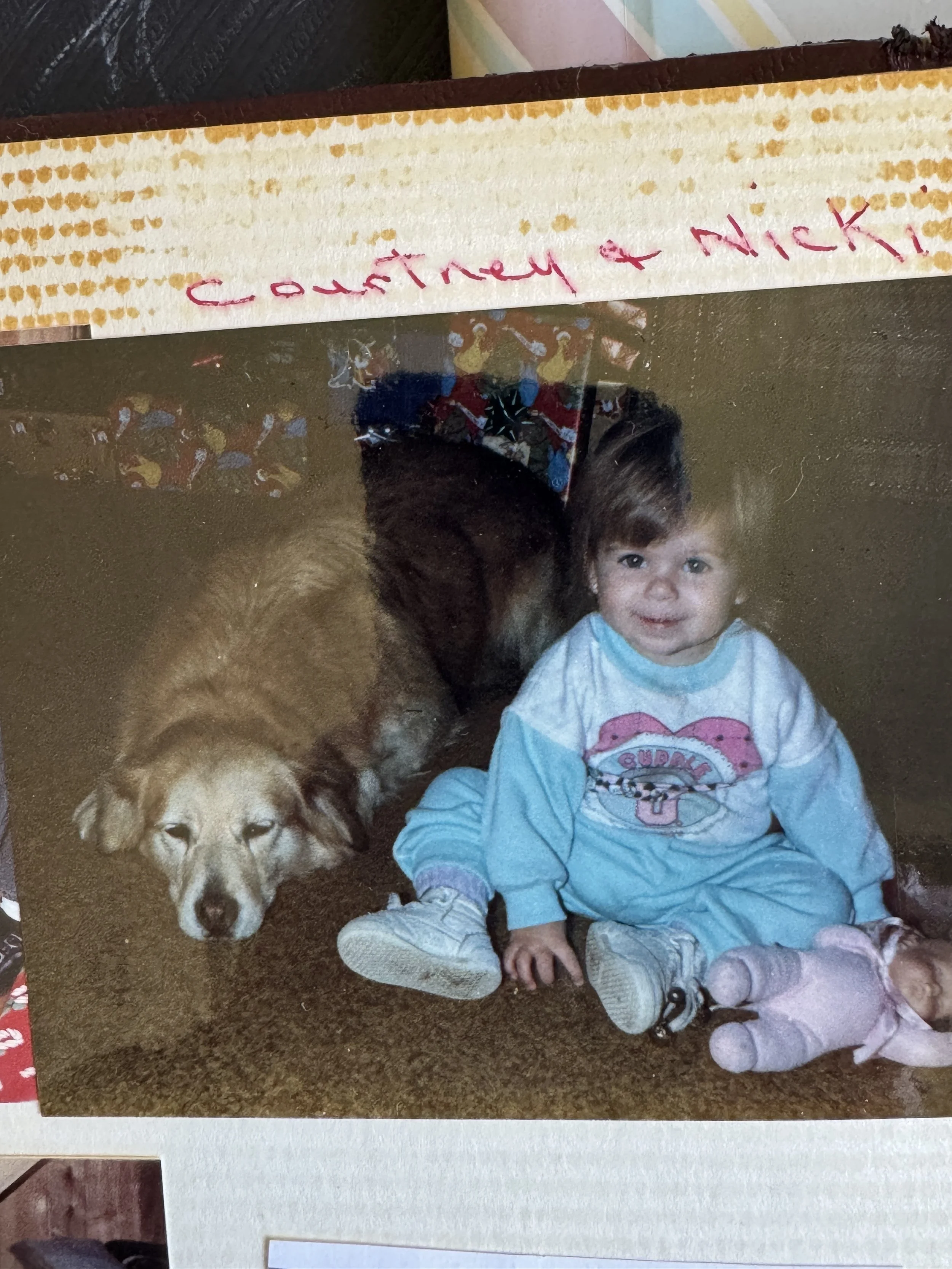
I’m not sure I remember her or only remember through the photographs my Nanny took of us throughout my early childhood. Nikki came from an accidental litter — Prissy, my mom's Siberian Husky, had a dalliance with the neighbor's Golden Retriever — and somehow she ended up as mine. My baby books are filled with her: lying on the floor beside me as an infant, playing with me in the yard, wearing her horse costume next to me in full cowgirl apparel on Halloween.
I don't remember when Nikki died. She stops appearing in the photos around my seventh birthday. I'm not sure I would remember her at all without those pictures.
Sometimes I wonder if what I have are actually memories — or only remembered snapshots.
That's the first lesson.
Since Nikki
Since that first goodbye, I've said goodbye more than 100 times.
From volunteering as a hospice foster home for the Great Pyrenees Rescue of Atlanta, to co-founding Rescue Ranch — a Boston Terrier rescue dedicated to special needs and medically fragile dogs that my wife Renee and I run from our farm in Rutledge — every goodbye has taught me something. About grief, about timing, about what dogs need from us at the end.
I've worked on this post more times than I'd like to count. Put it off, avoided it, gotten a lump in my throat trying to organize my thoughts. Grief is like that — it's like picking at the edge of a scab you know is going to scar.
So this may not be the most polished post I've ever written. When talking about loss, my thoughts get a little disjointed. I think that's honest.
There Is No Timeline on Grief
In It's OK That You're Not OK, Megan Devine writes about how we never really put loss behind us. We don't move on. We learn to carry it. We learn to live with a piece of ourselves missing while also carrying a piece of who we lost — and those pieces don't fit quite right. They poke us and cut us and bruise us. And we cherish them anyway. We cherish the sharp reminders even when they hurt.
I've found this true a hundred times over.
Some goodbyes I can write about quickly. A few hours after losing a hospice foster dog I've loved until their passing, I sometimes know exactly what I want to say — I feel it clearly and I want to share it while it's still fresh. Other goodbyes have needed weeks. When my horse Ginger passed in December of 2020, I couldn't look at the photos we'd had done together for four months. It was four months before I could share anything about her end of life portraits.
There is no rule about when you'll be ready. There is no timeline. But sharing does help. Talking about the ones we love — even when they're no longer here — makes us feel closer to them. Thumbing through my grandmother's cracked, yellowed 4x6 prints, I remembered what it felt like to have my small child's hands wrapped around Nikki's neck. I could feel how much I loved her. Sharing a little of her story brought her back to me for just a moment.
That's what photographs do. They carry the people — and the animals — we can no longer hold.
The Smiley Face Calendar
Learning when to make the call to end suffering has been one of the hardest lessons of running a senior and hospice rescue.
Our vet shared a piece of wisdom that forever changed how we think about this. He suggested keeping a calendar and marking each good day — where your dog feels well, enjoys the things they love, has an easy comfortable day — with a smiley face. And marking each hard day — where they don't feel good, don't enjoy what they used to love — with a frowny face.
When the frowny faces start to regularly outnumber the smiley ones, it's time to have the conversation.
He said: "It's better one day too early than one day too late."
If the greatest lesson dogs have taught me is to live in the moment — to fully enjoy the present — then the greatest gift we can give them is to let them go before the hard moments are all they have left.
What the Photos Give You After
I didn't understand, when I was seven and Nikki was still in every photo, that those pictures would eventually be all I had of her. I couldn't have understood that.
I understand it now.
The photographs you have of your dog are all the photographs that will ever exist. That's a fact that feels abstract until it suddenly isn't. Until you're reaching for your phone to take one more picture and realizing there won't be one more.
Take the pictures now. Take them on ordinary Tuesdays. Take them badly, with your phone, in terrible light. Take them with a professional camera in a wildflower field. Take them in every season of your dog's life. You will not regret having too many.
You will only ever regret the ones you didn't take.
→ Read next: