You've probably done it.
Scrolled through a photographer's portfolio late at night, stopping on an image that is beautiful — a dog posed perfectly in golden light, every detail intentional, the whole thing feeling almost cinematic.
And then you've thought — my dog could never look like that.
And maybe that’s true. Maybe your dog is a chaos gremlin. Maybe they have a giant underbite. Maybe they have never held a stay in their entire life and their idea of posing is launching himself towards your face.
But, I want to tell you something important.
Those breathtaking portfolio images — some of them are award-winning portraits. And they are stunning because they tell a story that a complete stranger can feel without any context at all.
But they are not the images that make my clients cry.
Maybe that’s not the image you could have of your dog. And maybe it’s not even the image you want of your dog.
Let me tell you about Tartufo.
Meet Tartufo
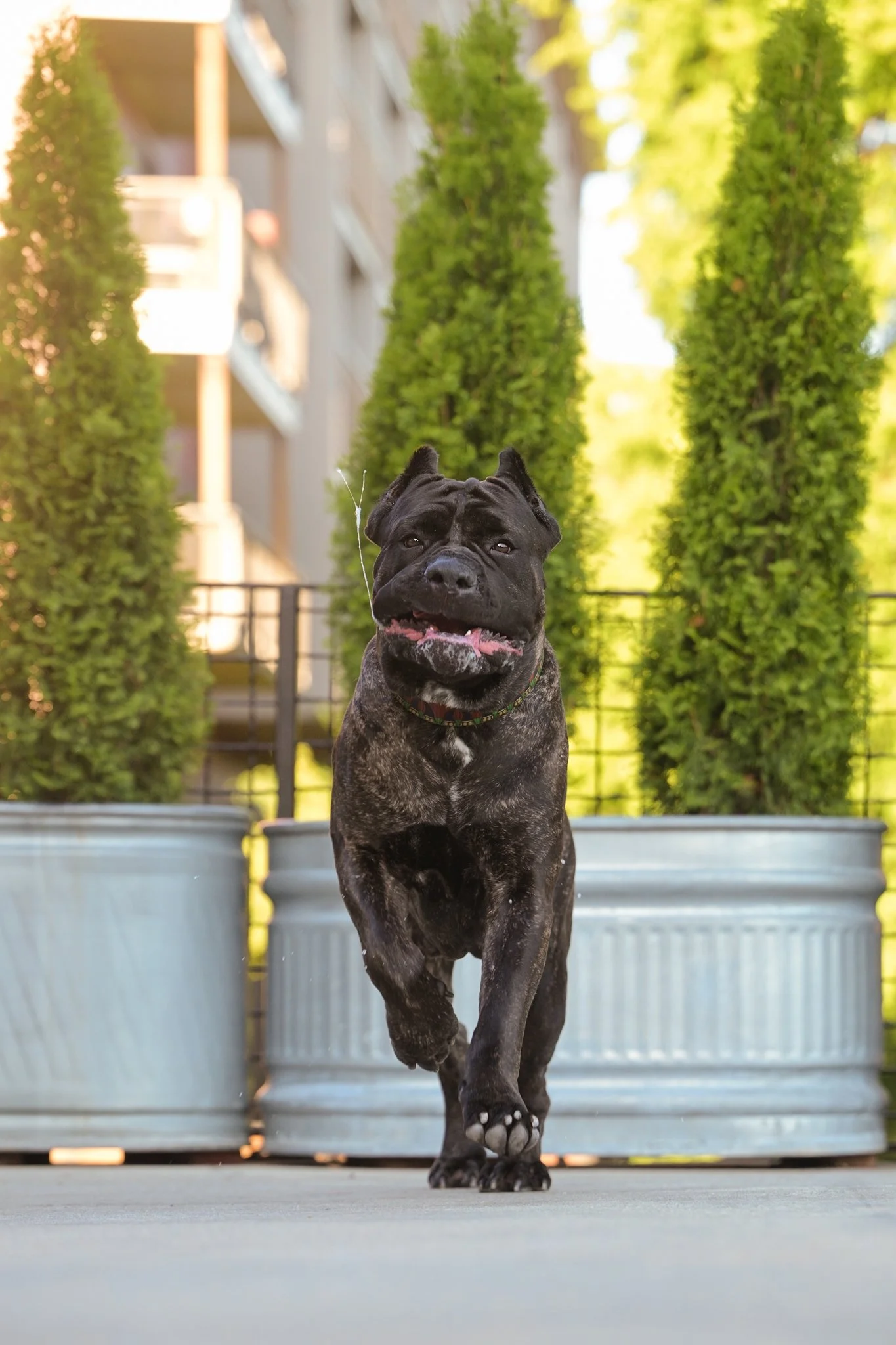
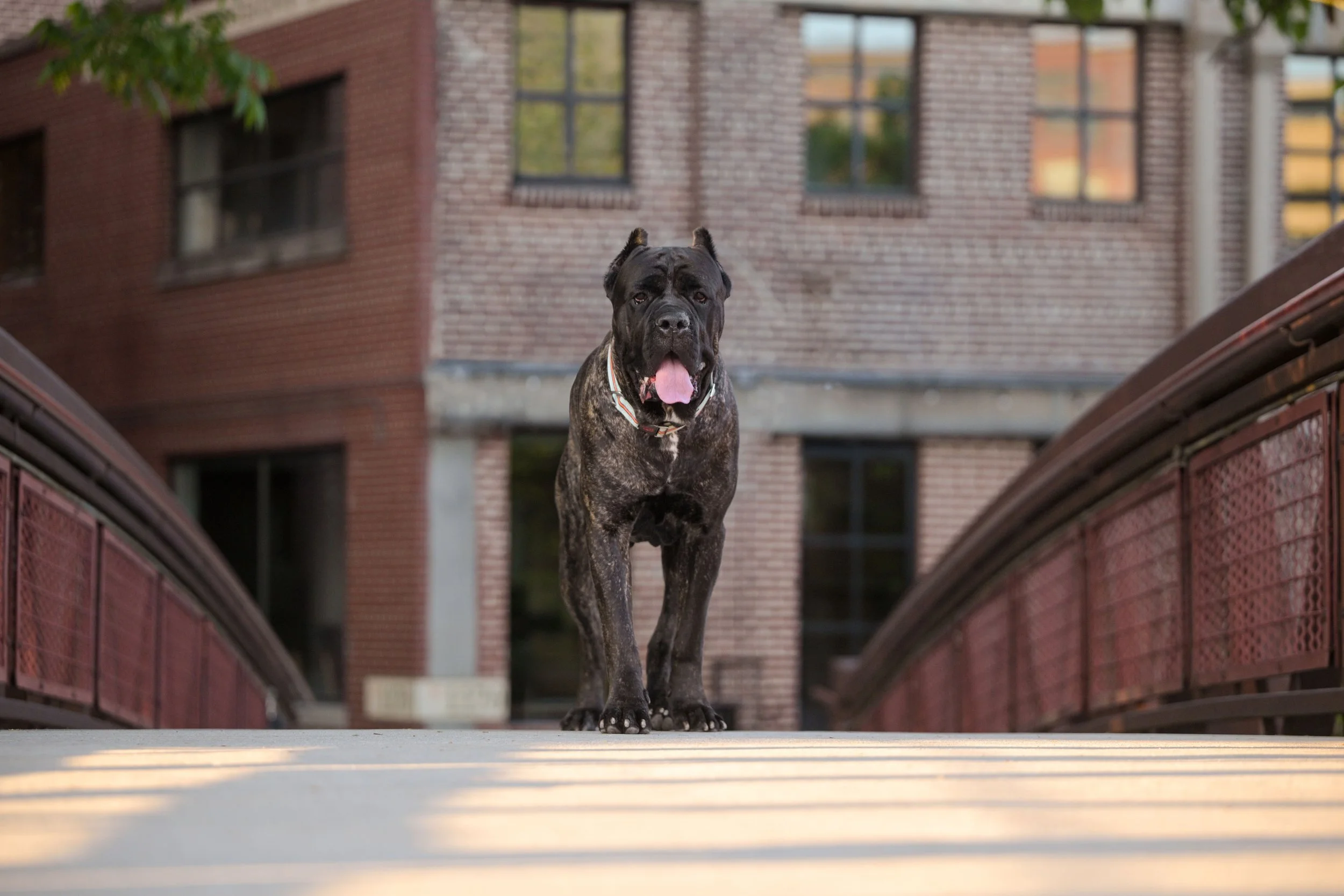
Tartufo is a Cane Corso. He is massive and brindle and has a tongue that seems to operate completely independently of the rest of his body.
He will put his entire mouth on your ponytail and walk away like he did you a favor.
He stole one of my little squeaky toys during his session and according to his mom, squeaked it the entire drive home.
He slobbered me more than once. He loved every second of it.
His sister Umbria — also a Cane Corso, also my client — is a lady who expects everything to have a certain decorum. She will tell you that Tartufo is basically a disgusting teenage brother. But that is his special charm. And it makes him completely irresistible.
The Image I Submitted
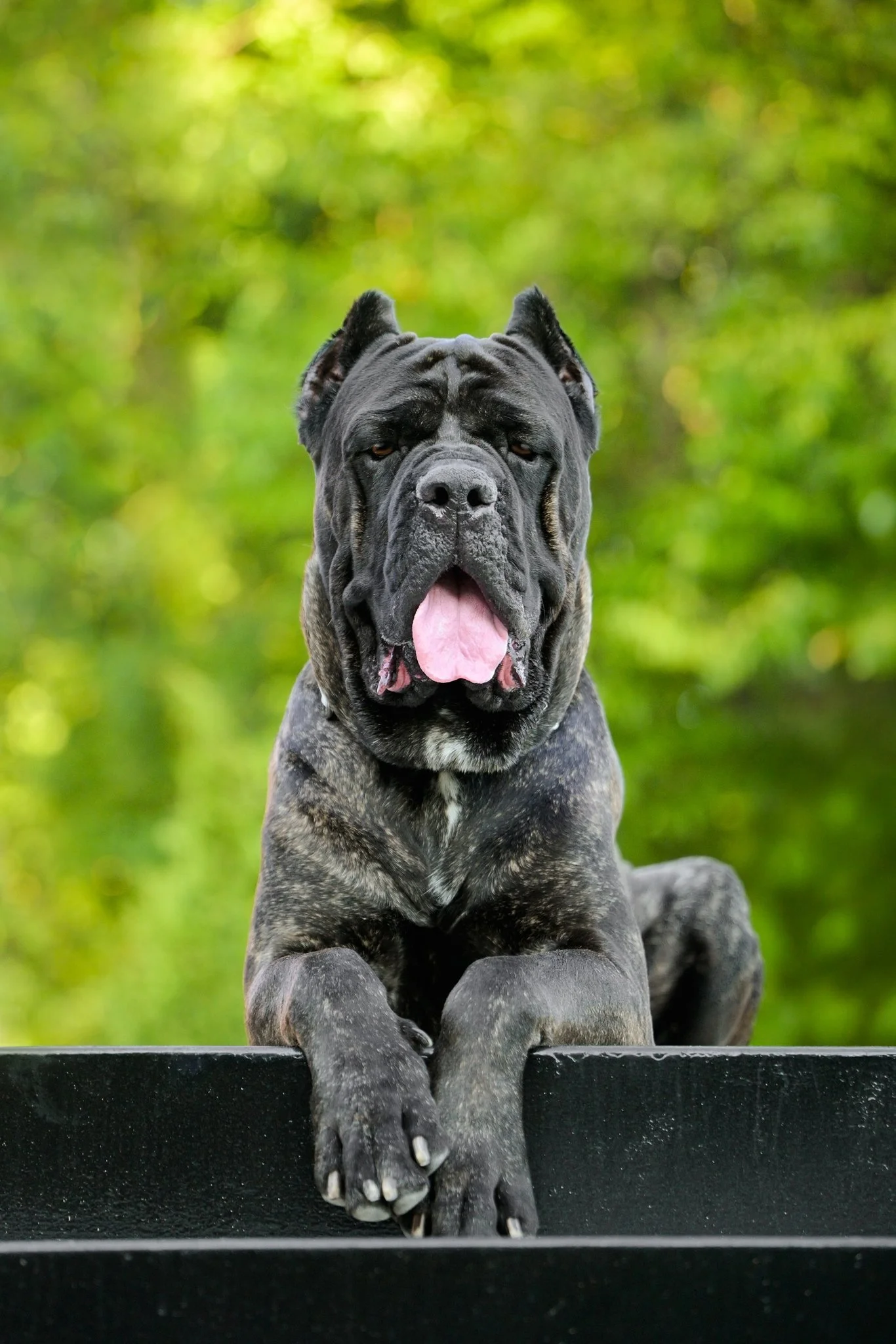
I have been working on Embark this year and I entered one of Tartufo's images into a photography competition — specifically a challenge focused on the concept of "get down." The idea is to take the photo from a low angle.
I photographed Tartufo at the top of a set of stairs, looking down at me, his enormous feet flopped over the edge.
I didn't make the top ten.
And when I watched the feedback video, I could see exactly why.
The critique — the eyes were too dark.
I thought — Courtney, you chose a dog with deep set eyes, more skin creating more shadow, looking down at you in less than ideal light.
And here’s the thing, I have a rule about locations. Find the light first. Everything else follows from there. I know this. I teach this. I wrote about it.
But I got so focused on solving for the challenge — get down, get the dog low — that I picked the location to meet the brief instead of finding the light and letting the brief meet me there.
That was the mistake. Not the dog. Not the edit. The order of operations.
Light first. Always.
Why I Would Still Put Every One of These Images in Tartufo's Gallery
Here is what I want you to understand.
When his mom sees these photos, she is not seeing what a judge sees.
She is seeing Tartufo.
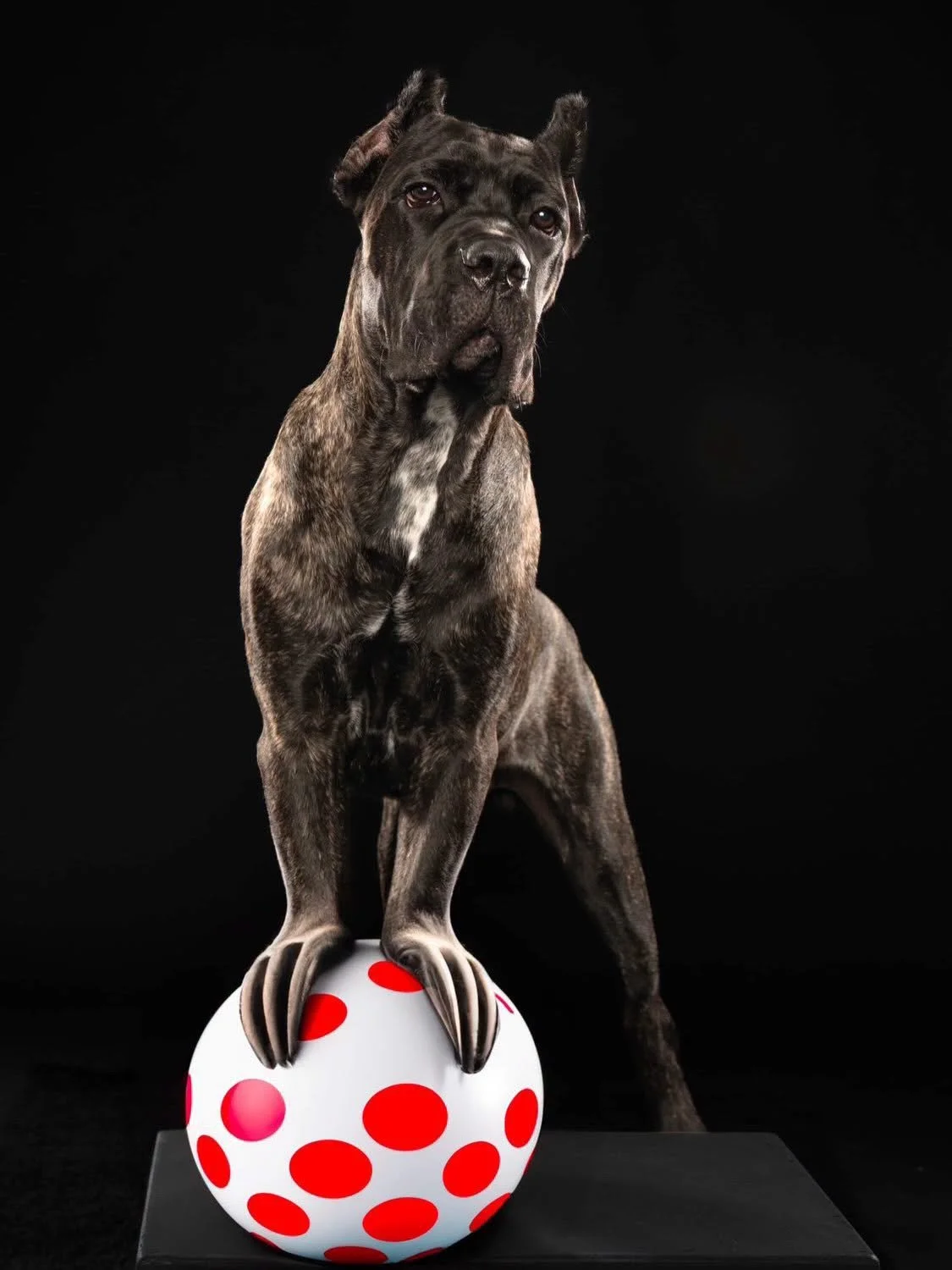
She is seeing those feet.
When Anna first brought Tartufo home as a puppy, she could not stop talking about how enormous his feet were. We called them flipper feet. I even did some ridiculous Photoshop once — turned them into actual walrus flippers, standing on a ball. We laughed until it hurt.
And there he is at the top of those stairs, giant feet flopped over the edge, and all I could think was — yep. Still a flipper foot.
A competition judge will never know that story. They will see a dark dog with dark eyes and no emotional connection to what is in front of them.
But Anna knows.
And that is the entire point of a client image.
The Difference Between a Client Image and a Competition Image
A client image is not trying to impress a stranger.
It is trying to reflect the dog that you see — the dog that you know — back to you. The client is who needs to see their dog in these images. Fully, completely, unmistakably themselves. The technical work exists to get out of the way so that all you see is them.
A competition image has to do something completely different.
It has to carry emotion all the way to a complete stranger using nothing but the choices the photographer made in camera and in the edit. No context. No history. No flipper feet backstory. No inside jokes. Just the image.
And here is something that might surprise you — the competition image is not actually about the dog in front of me at all. It doesn't matter what Tartufo's personality is. It doesn't matter that he steals squeaky toys or tries to pull the schrunchie out of ponytails. In a competition image, the dog is the subject of a story that lives entirely in the photographer's creative mind. I could have used any dog to tell that story. Tartufo just happened to be the one laying there.
The entire story is told through the photographer's vision — the lighting choice, where the dog is placed, how the edit is crafted, what is included in the frame and what is left out. Those technical decisions are the story. That is what the judges are evaluating. That is what competition mastery looks like.
A client image is the complete opposite.
There is no story without your dog. Your dog is not the subject of my story. Your dog is the story. Every creative decision I make — the location, the light, the angle, the moment I press the shutter — exists in service of showing who this specific animal is to the people who love them.
That is a fundamentally different thing. And it is why I do both.
Why I Still Do Competition Work
Here is the thing that most people don't know about why I continue to do competition work alongside client work.
It is not about the ribbons.
It is about mastery. It is about doing the technical work so many times, in so many conditions, under so much pressure, creating stories out of nothing, that it becomes muscle memory. Because the moment all of that becomes automatic — the light, the exposure, the composition, the timing — it can get completely out of the way.
And the only thing I am thinking about when I am photographing your dog at your Signature Session is your dog and the chapter of the story you’re telling together.
That is the goal. That has always been the goal.
To meet the client bar, I have to know your dog before I ever pick up my camera. I have to know their history. Their stories. The little quirks and physical characteristics that you think of immediately when someone asks you to describe them. The things that make you love them.
And my goal is not to show your dog to the rest of the world.
My goal is to reflect the dog that you see — the dog that you know — back to you.
So Are My Dog's Photos Worth It?
The question underneath all of it is usually this.
Is this worth it? Is my dog worth it? Am I allowed to spend this kind of money on photographs of my pet?
And the answer — every single time, without exception — is yes.
Not because the images might win something someday.
Because fifteen years from today, when you open your album, you will be taken back instantly.
You won't just see your dog.
You will feel them.
You will stop feeling the leather of your album cover because you will be feeling their fur beneath your fingers. You won’t be seeing archival paper because you’ll be seeing that glint in their eye that always meant a zoomie was moments away.
That is what a great portrait does. That’s what make a portrait something different than an image. A portrait is a reflection of the subject.
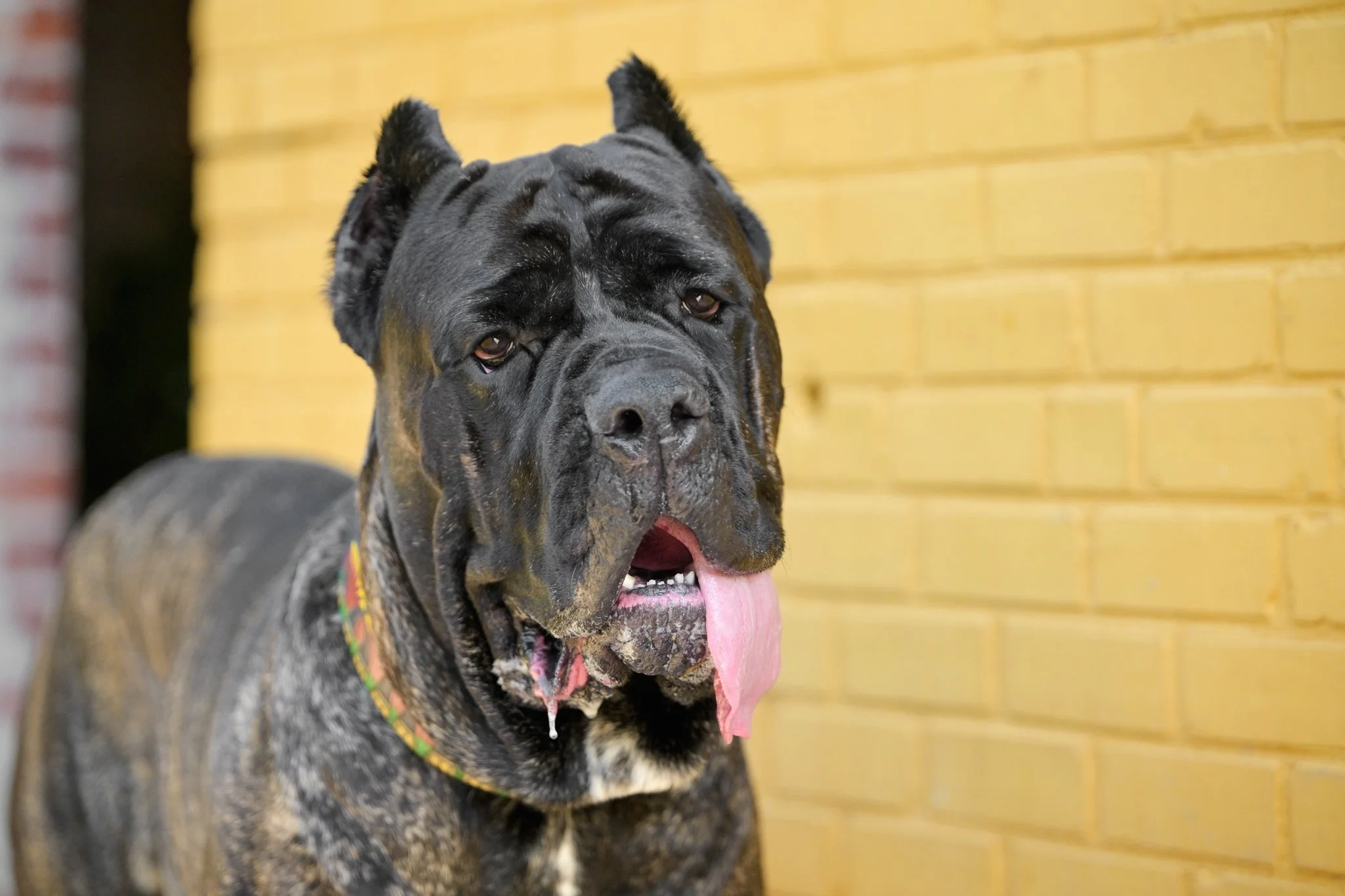
Tartufo's images may never make it to the winner's circle of a photography competition. But they are going to live in Anna's album and on Anna's walls, and every single time she opens that cover she is going to be taken straight back to the day her very large, very silly dog flopped his giant tongue out of his mouth to cheese for the camera.
That is worth every penny.
→ Read next: