
Composition in photography is how elements within an image are arranged — the decisions about where to place your subject, how much space to give them, what's behind them and around them and how it all relates.
For the Embark challenge on composition, the assignment was deceptively simple: centering. Place your subject at the exact center of the frame.
Simple in concept. Not simple when your subject is a dog.
I always tell clients that in any given session, I'm working toward "close enough" — a general area where the light is beautiful and there's room for the dog to be wherever they naturally land. But a perfectly centered composition requires a dog placed with precision. Every paw exactly where it needs to be.
I needed the right dog. And I had a very specific idea about where we were going.

Meet Me at the Cemetery
I'd been thinking about Oakland Cemetery for months.
Atlanta's iconic historic cemetery — full of remarkable Victorian architecture, carved stone, and atmosphere that doesn't exist anywhere else in the city — kept appearing in my mental image library. When I came across a photo of the Richards Mausoleum at a wedding shoot, I stopped scrolling. The huge copper door. The scale of it. The gravitas.
I could see a dog centered on that door. A big, impressive dog. A dog that could hold a position with the precision the image required.
I started planning.
Umbria — The Cane Corso
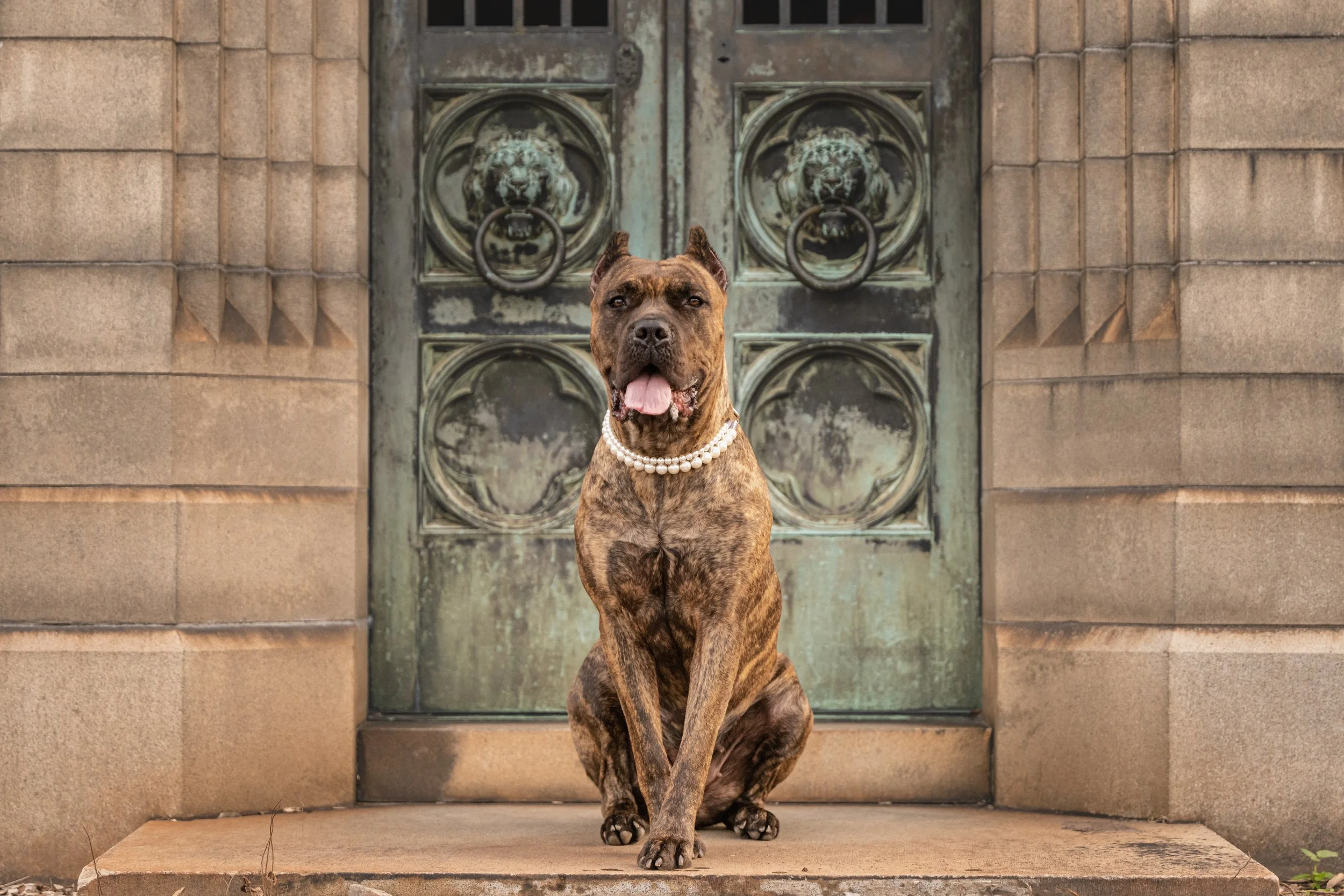
When Anna and her Cane Corso Umbria applied for the Embark challenges, I immediately thought of this image.
Umbria is stunning — brindle coat, exceptional presence, the kind of dog who commands a frame without trying. More importantly, she has beautiful manners and the training foundation to be placed with precision and trust. This image doesn't work with a dog who won't hold a position.
I pitched the plan to Anna: meet me at the cemetery, at dawn.
To her enormous credit, she agreed. And Umbria agreed to forgo a bit of beauty sleep in exchange for Wild Weenies.
Getting the Final Image
We tried every variation — closer to the door, farther away, sitting, standing, lying down, different distances, different focal lengths. I needed Umbria to fill the door in a specific proportion, centered precisely, her gaze direct.
The image that worked was Umbria in a stand-stay, centered, filling the enormous copper door, her brindle coat and the aged green copper contrasting beautifully.
The final image was one of my favorite pieces of work from the entire Embark series. It exists because of a specific dog, a specific location, a specific light, and a client who trusted me enough to meet a photographer at a cemetery at dawn.
That's what the best images require.
What Composition Actually Is
For dog photography specifically, composition is about creating intentional visual relationships — between the dog and their environment, between where you place your subject and what that placement communicates.
Centering creates symmetry and stability — the subject is equal to everything around them, powerful, balanced. Off-center placement creates movement and tension — the eye follows the negative space, the subject feels in motion or in relationship to something outside the frame.
Neither is better. Both serve different emotional purposes.
What matters is that the choice is intentional — not just where the dog happened to land.
→ Read next: